How to Convert HEIC to PNG (Free, No Upload)
Convert HEIC photos to PNG for free in your browser. Why iPhone photos won't open on Windows or in old apps, and how to fix it in seconds.
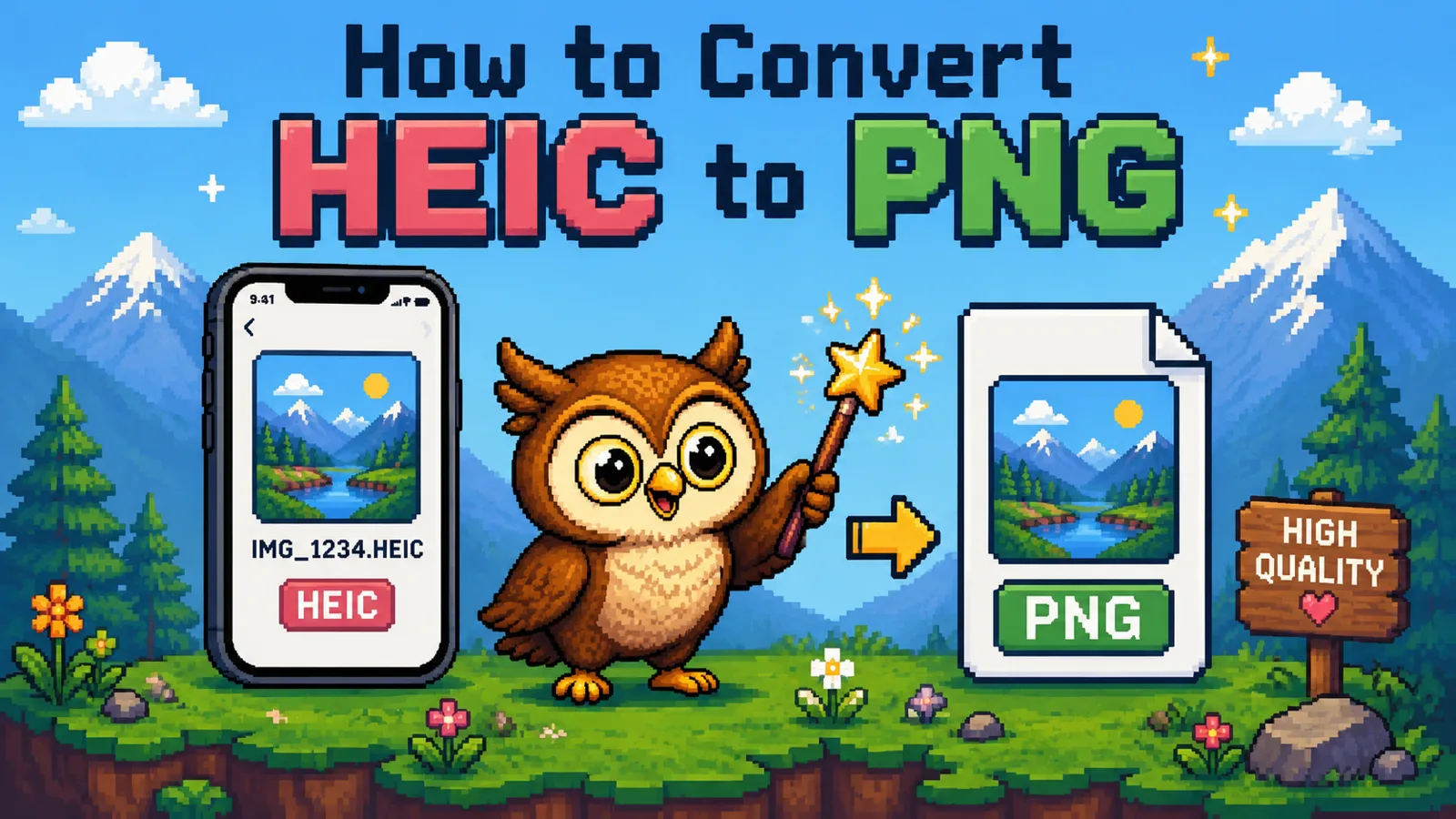
You AirDrop a photo from your iPhone to a Windows PC, or drag one into an old design tool, and nothing opens. The file ends in .heic, and outside Apple's own apps, a lot of software still doesn't know what to do with it. The fix is to convert it to PNG, a format every image tool on earth can read, and you can do it free with our HEIC to PNG tool, entirely in your browser.
Here's what HEIC actually is, why it doesn't open everywhere, and how to convert it in under a minute. (For more browser-based fixes like this one, see our other how-to guides.)
What is a HEIC file, and why doesn't it just open?#
HEIC (High Efficiency Image Container) is the photo format iPhones have used by default since iOS 11. It stores pictures using the same compression approach as HEVC video, which is why a HEIC photo looks as good as a JPEG at roughly half the file size. Apple's own explanation of the format covers the trade-offs in its HEIF and HEVC support documentation.
The problem is everything outside Apple's ecosystem. Windows only gained partial HEIC support through an optional codec extension, most web forms and CMSes reject it outright, and plenty of older image editors have never heard of it. PNG has none of those gaps: it's been the universal, lossless image format since the 1990s, and nothing rejects it.
Step 1: Open the HEIC to PNG tool#
Go to convertowl.com/heic-to-png. No sign-up, nothing to install. The conversion happens locally using your browser's own image decoding, so the HEIC file is never uploaded anywhere, which is useful when the photos are personal or you'd rather not hand them to a third-party server. Files up to 50 MB are supported.
Step 2: Drop in your HEIC file (or a batch of them)#
Drag the .heic file onto the page, or click to browse for it. If you exported a whole album from your iPhone, you can drop them all in at once; the tool converts each one and gives you a separate PNG per file.
Step 3: Convert and check the preview#
Conversion starts automatically once the file loads. Because PNG is lossless, the pixels are decoded from the HEIC and re-saved exactly, with no quality lost in the process: what you see in the preview is what you get in the download.
Step 4: Download your PNG#
Click download and the file lands in your downloads folder, ready to open anywhere: Windows Photo Viewer, macOS Preview, Word, PowerPoint, an upload form that only accepts "standard" image types. If you were only converting because a specific tool couldn't read HEIC, this is the last step.
A trade-off worth knowing: PNG files are bigger#
Converting HEIC to PNG is a compatibility fix, not an upgrade: expect the file size to go up, often a lot. HEIC's whole advantage is efficient, modern compression; PNG uses older, lossless compression that can't match it. A 2 MB HEIC photo can easily become a 6–8 MB PNG. That's normal, and it's the price of universal compatibility. If the resulting PNG is too large for an email or upload form, run it through Compress Image afterward, and it'll shrink it back down without you having to touch the HEIC again.
PNG isn't always the right target#
PNG is the safest choice when you need lossless quality or the image has transparency, but for ordinary photos it's often more file than you need. If you just want something smaller that still opens everywhere, HEIC to JPG is usually the better call: JPG keeps file sizes closer to the original HEIC while still being universally supported. We cover that comparison in more detail in our guide to converting HEIC photos from iPhone to JPG. Reach for PNG specifically when you need pixel-perfect fidelity: a screenshot, a graphic with sharp edges, or an image headed for print.
FAQs#
Why won't my HEIC photos open on Windows or in older apps?#
HEIC is the default photo format on iPhones since iOS 11, and outside Apple's own apps, a lot of software, including much of Windows without an added codec, has no built-in support for decoding it. Converting the file to PNG sidesteps the issue, since PNG is supported by essentially every image tool ever made.
Does converting HEIC to PNG lose image quality?#
No. PNG is a lossless format, so converting from HEIC to PNG preserves every pixel exactly as it was decoded, with no added compression artifacts. The trade-off is file size, not quality: the PNG will typically be several times larger than the original HEIC.
Why is my PNG file so much bigger than the original HEIC?#
HEIC uses efficient, modern compression based on the HEVC video codec, while PNG uses older lossless compression that can't shrink an image nearly as much. Going from HEIC to PNG trades a smaller file for universal compatibility, and if the size becomes a problem you can compress the PNG afterward.
Should I convert HEIC to PNG or to JPG?#
Convert to PNG when you need lossless quality or transparency, like a graphic or a screenshot; convert to JPG for ordinary photos, since it keeps the file size much closer to the original HEIC while still opening everywhere. Most everyday iPhone photos are better served by JPG.
Is it safe to convert private photos this way?#
Yes. The conversion runs entirely inside your browser using your device's own image decoding, so the HEIC file is never uploaded to a server or seen by anyone else. This matters for personal photos or anything else you'd rather not hand to a third-party service.
Can I convert multiple HEIC files to PNG at once?#
Yes, the HEIC to PNG tool accepts multiple files in one go and converts each one to its own PNG, which is faster than converting a folder of photos one at a time.
Ready to convert? Open the free HEIC to PNG tool, drop your file, and get a PNG that opens anywhere: no upload, no watermark, no account.
Try the tools
Free, private, and instant. Everything runs in your browser.