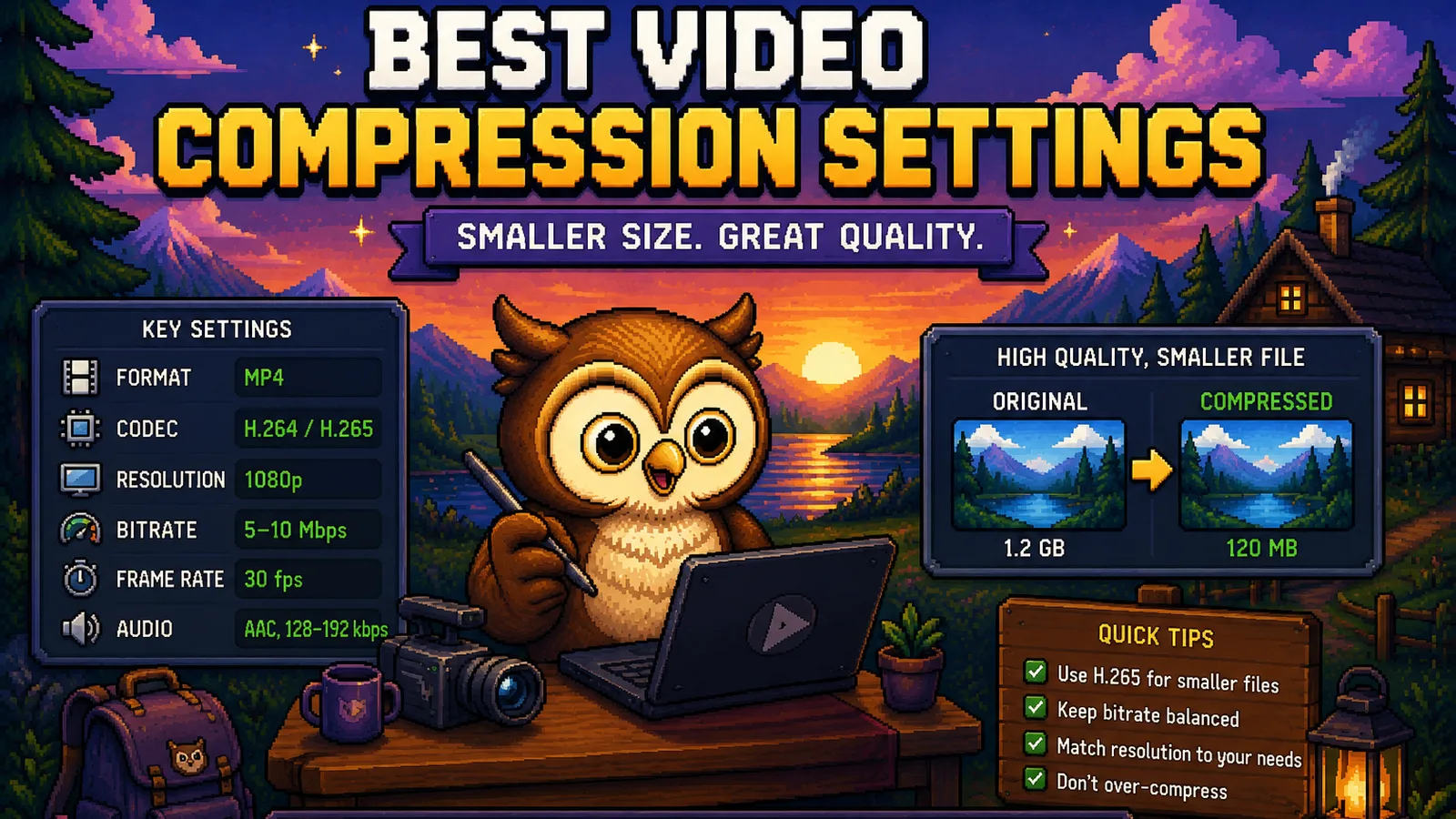
Which Video Format Has Better Quality?
MP4, MOV, WebM, and MKV compared on actual visual quality: codec, bitrate, and resolution, not just compatibility. Here's what really matters.

"Which video format is highest quality?" is a common question, and the honest answer is that the container (MP4, MOV, WebM, MKV) barely affects quality at all. Quality comes almost entirely from three other things: the codec compressing the video, the bitrate it's compressing to, and the resolution you started with. Get those three right and it genuinely doesn't matter much whether the file ends in .mp4 or .mkv. Get them wrong and no container will save you.
This guide breaks down what actually determines how good a video looks, so you can stop guessing based on file extension.
The container isn't where quality comes from#
A video file is a wrapper around a video stream, an audio stream, and metadata. MP4, MOV, WebM, and MKV are all just different ways of packaging that same data. None of them re-encode or degrade the video just by existing: an H.264 video inside an MP4 looks identical to the same H.264 video inside an MKV, because it's the same compressed data either way. If you're moving between containers without changing the codec, you're repackaging, not converting quality up or down.
This is why converting MOV to MP4 is normally lossless: both containers commonly hold the same H.264 or H.265 stream, so the conversion just changes the wrapper.
What actually determines quality#
The codec#
The codec is the compression algorithm applied to the raw video before it gets stored. Different codecs squeeze more or less detail into the same file size:
- H.264 (AVC): the oldest and most universally supported of the modern codecs. Solid quality, but the least efficient of the four, meaning it needs a higher bitrate to match the others' quality.
- H.265 (HEVC): roughly 40-50% more efficient than H.264 at the same visual quality, which is why iPhones default to it for a given file size. Support is good but not universal.
- VP9: Google's codec, used heavily in WebM files and by YouTube. Comparable efficiency to H.265, royalty-free, and the reason WebM files often look as good as MP4 at a smaller size.
- AV1: the newest and most efficient codec, squeezing out noticeably more quality per byte than any of the above, at the cost of slower encoding and less universal playback support.
A newer, more efficient codec at a given bitrate will beat an older codec at the same bitrate, every time. That's a bigger factor than the container it's wrapped in.
The bitrate#
Bitrate is how much data the codec is allowed to spend per second of video, and it's the single biggest lever on visible quality. A video encoded at 2 Mbps will show compression artifacts (blockiness in motion, smeared detail) that the same footage encoded at 10 Mbps won't. This is also the main reason a heavily compressed file looks worse: dropping the bitrate to shrink the file trades detail for size, on purpose.
The source resolution and re-encoding history#
You can't get quality back that wasn't captured in the first place. A video shot or exported at 720p will never look as sharp as one shot at 4K, no matter which codec or container you pick afterward. And every time a video gets re-encoded (converted from one lossy codec to another), it loses a small amount of quality, since the new encoder is compressing an already-compressed approximation of the original. That's why straight container swaps (MOV to MP4 with the same codec) are lossless, while codec changes (MP4 with H.264 to WebM with VP9) involve a re-encode and a small, usually invisible quality cost.
Step 1: Check what codec is actually inside your file#
The file extension doesn't tell you the codec. A video app, media player, or a tool like ffprobe can show you: right-click the file and check its properties, or open it in VLC and look at Codec Information. Two .mp4 files can use completely different codecs with very different quality at the same size.
Step 2: Match the codec to where the video is going#
If you're archiving footage and want maximum quality retained, keep the highest-bitrate, most efficient codec available (H.265 or AV1) and avoid unnecessary re-encodes. If you're sharing or uploading somewhere with strict compatibility needs, H.264 in an MP4 remains the safest bet even though it's the least efficient, because nearly everything can decode it without issue.
Step 3: Convert without losing more than you have to#
When you do need to change format, use a tool that keeps the codec intact where possible rather than always forcing a re-encode. MOV to MP4 repackages Apple footage for wider compatibility with no quality loss in most cases. MKV to MP4 does the same for downloaded or ripped video that won't play on your device. MP4 to WebM does involve a re-encode (H.264 to VP9), but at a matched bitrate the quality difference is usually imperceptible, and the resulting file is often smaller. All three run locally in your browser, so nothing uploads anywhere and there's no wait for a server to process your file.
Quick comparison#
| Factor | What it controls | Bigger effect on quality than the container? |
|---|---|---|
| Codec (H.264, H.265, VP9, AV1) | Compression efficiency at a given size | Yes |
| Bitrate | How much detail survives compression | Yes, the biggest single factor |
| Source resolution | The ceiling on possible sharpness | Yes |
| Container (MP4, MOV, WebM, MKV) | How the streams are packaged | No, mostly irrelevant to quality |
If you're comparing formats purely on compatibility and file size rather than quality, Which Video Format Is Best? covers that side in more depth.
FAQs#
Does MKV have better quality than MP4? No, not inherently: MKV is just a container, and the video codec inside it, not the container, determines quality, so an MKV and an MP4 holding the same codec at the same bitrate look identical.
Is WebM lower quality than MP4? No, WebM's typical VP9 codec is generally more efficient than MP4's typical H.264 codec, meaning a WebM file often looks as good or better than an MP4 at the same file size, not worse.
Does converting a video lower its quality? It depends on what changes: repackaging into a new container while keeping the same codec (like MOV to MP4) is normally lossless, while converting between codecs (like H.264 to VP9) involves a re-encode that loses a small, usually invisible amount of quality.
What's more important for quality, resolution or bitrate? Both matter, but a high resolution encoded at too low a bitrate still looks worse than a lower resolution encoded generously, since bitrate determines how much of that resolution's detail actually survives compression.
Why does my iPhone video look better than a downloaded video at the same file size? It's almost certainly the codec: newer iPhones record in H.265, which is significantly more efficient than the H.264 that many older or web-sourced videos still use, so it packs more visible quality into the same number of megabytes.
Should I always pick the newest codec for the best quality? For pure quality-per-byte, yes, AV1 or H.265 will beat H.264 at a matched bitrate, but check playback support first, since older devices and some editing software still only handle H.264 reliably.
The short version#
- The container barely affects quality. MP4, MOV, WebM, and MKV are packaging, not compression.
- The codec, bitrate, and source resolution do the real work. A newer codec (H.265, AV1) beats an older one (H.264) at the same bitrate, and bitrate is the single biggest lever on visible detail.
- Repackaging is lossless; re-encoding costs a little. Swapping containers with the same codec inside loses nothing; changing codecs involves a small, usually invisible trade-off.
- Match the codec to the destination, not the file extension, when quality actually matters.
Need to move a video between formats? MOV to MP4, MKV to MP4, and MP4 to WebM all run locally in your browser: no upload, no account, no quality lost that the codec change doesn't already account for.
Try the tools
Free, private, and instant. Everything runs in your browser.